

Before launching on Amazon U.S., a brand needs to validate that the business can work, build the infrastructure required to launch correctly, and create a system capable of turning early sales into profitable growth. In practice, that means moving through three stages: Exploration, Launch, and Grow.
After more than 20 years working with consumer brands, I’ve seen a recurring pattern when companies start thinking about entering the U.S. market. The conversation quickly becomes operational. How much inventory should we send? Where should we store it? How do we open the Amazon account? How quickly can we get the products live?
Those are important questions, but I think they come later than most teams expect. Before committing inventory, advertising dollars, logistics costs, or months of a team’s time, there is a more fundamental question to answer: Do the numbers work?
A brand needs evidence that its product has a credible place in the U.S. market, that consumers will accept the price it needs to charge, and that enough margin remains after the real costs of operating in the market. Only then does it make sense to build the infrastructure behind the launch and begin investing in growth.
At HatchEcom, we think about that journey as Exploration → Launch → Grow. Exploration is about deciding whether and where to play before committing significant capital. Launch turns that decision into an operating Amazon business. Grow is where content, advertising, inventory, compliance, and performance management begin working together to build sustained growth.
Each stage should provide enough evidence to justify the investment in the next one.
Why Amazon U.S. requires more than a launch plan
The opportunity is significant. According to Amazon’s 2025 Small Business Empowerment Report, independent sellers sold more than 4.6 billion items in Amazon’s U.S. store in 2025. More than 75,000 independent sellers generated over $1 million in annual sales, an increase of 36% from the previous year, while U.S.-based independent sellers averaged more than $375,000 in annual Amazon sales. Amazon’s report provides more detail on the scale of its independent seller ecosystem.
The broader U.S. ecommerce market continues to expand as well. According to the U.S. Census Bureau, ecommerce sales reached $340.2 billion in Q2 2026, up 12.2% year over year and representing 17.1% of total U.S. retail sales.
That scale is what makes the market so attractive to brands outside the U.S., but it is also what makes a poorly prepared launch expensive. Getting a product listed is relatively straightforward compared with building a business that can compete on price, maintain inventory, convert traffic, absorb marketplace and logistics costs, and continue investing after the first shipment sells through.
This is why our philosophy at HatchEcom starts with feasibility before investment. We measure success by profitability and sustained growth, not simply by getting products into a marketplace.
And that work starts before the first shipment.
Stage 1: Exploration. Validate the business before investing
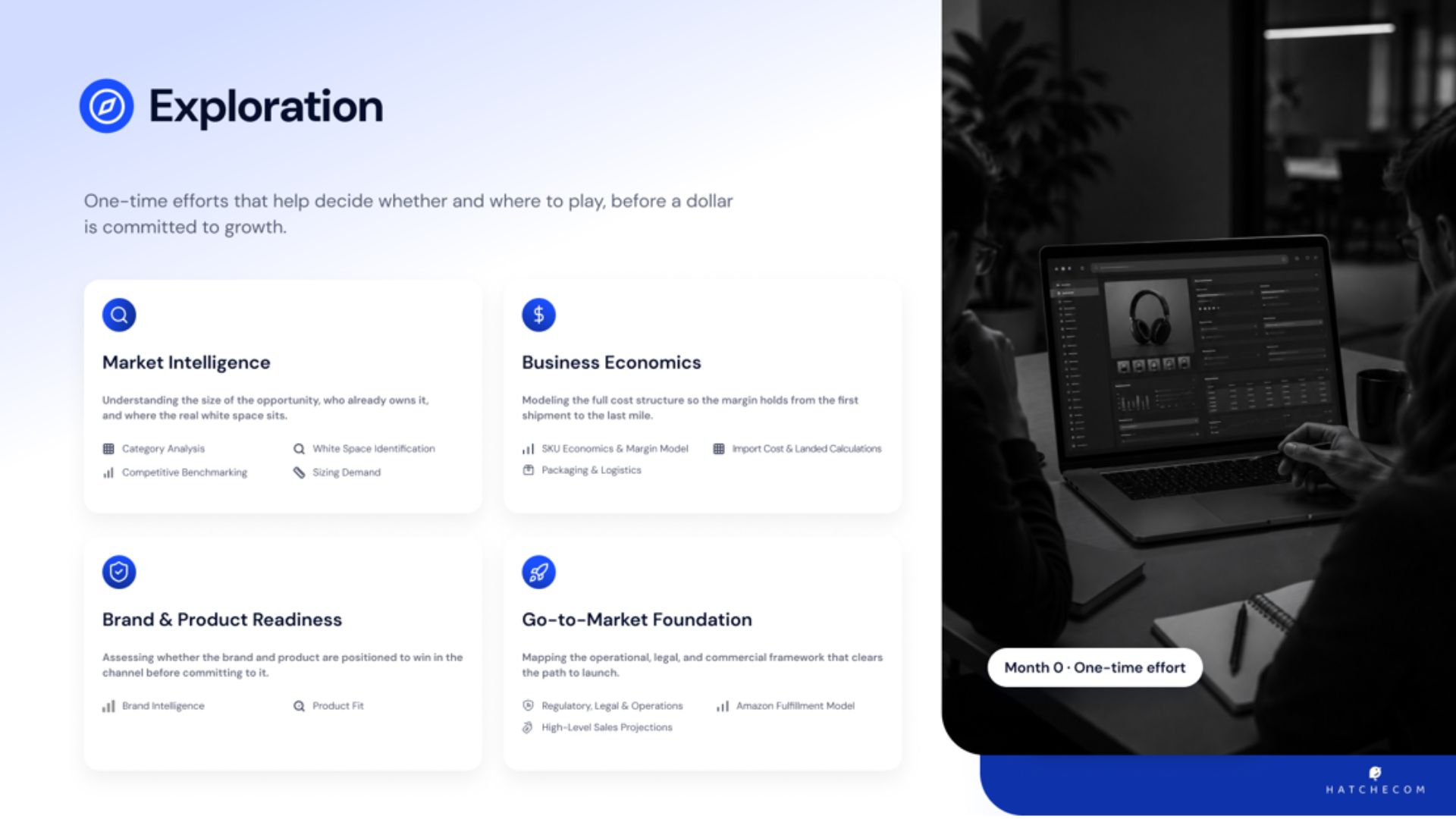
Exploration should answer one fundamental question: Is there a viable U.S. business here?
That is different from asking whether a product can technically be sold in the United States. Most brands can find a way to list a product. The more important question is whether there is enough demand, whitespace, pricing power, and margin to justify the investment required to compete.
At HatchEcom, Exploration looks at four connected areas: Market Intelligence, Business Economics, Brand & Product Readiness, and the Go-to-Market Foundation. That means understanding the opportunity and competitive environment while simultaneously modeling the economics and identifying operational or regulatory requirements that could change the decision.
Start with the category, not the product
One of the easiest mistakes to make is assuming that category growth automatically creates an opportunity for a new brand. A category can grow while competition grows even faster. Revenue can rise because prices are increasing even if unit demand is flat. A few established brands can control most of the category, or the opportunity may exist primarily at price points your cost structure cannot support.
That is why category research needs to go beyond market size. I want to understand who already owns the space, how much demand exists, where consumers are underserved, which products are winning, how shoppers search, what they complain about in reviews, and what price points are actually moving.
Amazon itself increasingly provides sellers with tools to make those decisions. Its Product Opportunity Explorer uses Amazon search and purchasing behavior to analyze factors such as demand, competition, pricing, reviews, returns, and unmet customer needs. Amazon reports that products launched using insights from the tool have 2.5 times higher sales potential during their first three months. That is Amazon’s own measurement rather than a guarantee of performance, but the principle behind it is important: better research before launch gives you better information for deciding where to invest.
We go deeper into the signals we use to evaluate a category in our HatchEcom guide on how to evaluate market opportunity in a U.S. product category.
Work backward from the U.S. retail price
Once there appears to be an opportunity, the next question is whether the economics support it. This is one of the most important exercises I do with brands entering the U.S., because the calculation often begins in the wrong direction.
A company might start with its manufacturing or FOB cost, add the margin it wants, and use that to determine a U.S. retail price. I prefer to reverse the equation. Start with the price the U.S. consumer is already willing to pay for comparable products, then work backward through the real costs required to sell there.
That means accounting for marketplace fees, fulfillment, international and domestic logistics, duties and tariffs, storage, expected advertising, promotions, returns, and other operating expenses before determining what margin remains for the product. Amazon’s Professional selling plan currently costs $39.99 per month plus applicable selling fees, while referral fees vary by category and services such as FBA introduce additional costs. Amazon maintains its current pricing and fee structure here.
This exercise sometimes produces an uncomfortable but extremely useful conclusion: a product can sell on Amazon and still be a bad U.S. business. If consumers are willing to pay $29.99 but the economics only work for the brand at $44.99, sending 2,000 units to the U.S. will not solve the problem. It simply makes the problem more expensive.
That is why a proper U.S. Market Opportunity Assessment needs to evaluate more than how attractive a market appears. It needs to determine whether your specific product, price, positioning, and cost structure give you a viable way to compete within it.
Make sure the product is ready for the U.S. shopper
The economics can work and the product can still be wrong for the market. Packaging, sizing, claims, product format, value proposition, and pricing expectations can vary considerably between countries. Something that is immediately understood in one market may require different education or positioning in another.
For that reason, HatchEcom treats Brand & Product Readiness as part of Exploration rather than something to discover after launch. You want to discover that a pack size is wrong, a claim does not translate, or the competitive set communicates the benefit differently before thousands of finished units are sitting in a U.S. warehouse.
At the end of Exploration, there should be a real business decision: move forward, adjust the proposition, or stop. A No Go is not a failed market-entry project. Discovering that the economics or product-market fit do not work before committing significant capital is exactly what good market-entry research is supposed to accomplish.
Stage 2: Launch. Build the operation behind the listing
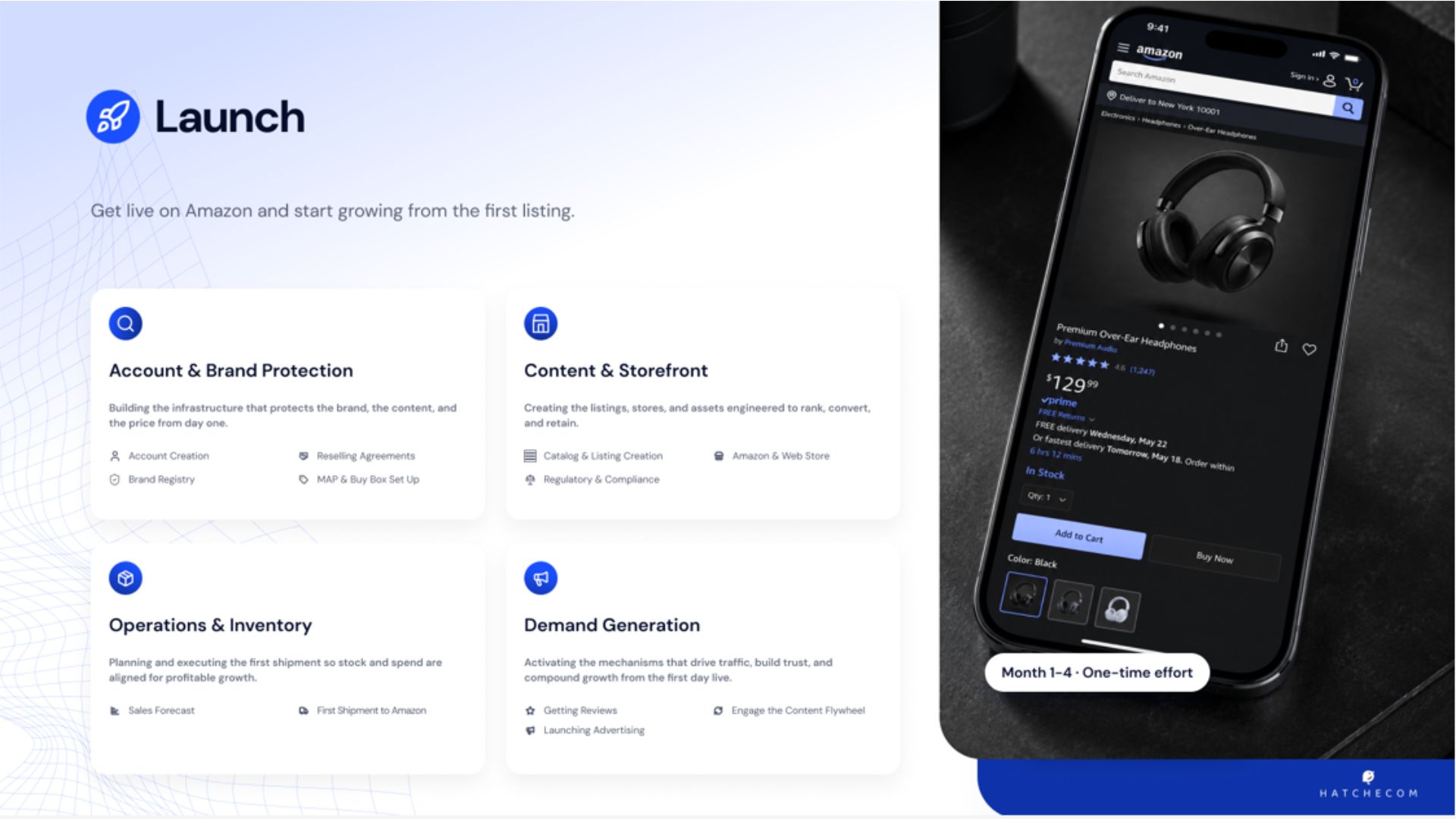
Once the opportunity has been validated, the conversation changes. Now the question is not whether there is a business worth pursuing, but what needs to be in place to operate it correctly.
This is where legal and financial structure, marketplace setup, compliance, brand protection, content, fulfillment, logistics, and inventory need to come together. A strong launch is not simply the moment a listing goes live. It is the point at which the infrastructure behind that listing is capable of supporting actual demand.
Choose the right operating structure
One common misconception among international brands is that selling on Amazon U.S. automatically requires forming a U.S. company and opening a U.S. bank account. Amazon’s current Global Selling guidance for Latin American businesses states that a U.S. business entity or bank account is not necessarily required to expand into the U.S. Amazon also notes that establishing a U.S. entity may be advantageous depending on a company’s specific business and sales strategy.
For that reason, I would not treat U.S. entity formation as a universal box every brand needs to check. The objective is to establish the right legal, tax, financial, import, and operating structure for the business you intend to build, with the appropriate professional guidance.
The same principle applies to compliance. There is no universal compliance checklist that works for every consumer product entering the U.S. Cosmetics, food and beverage, supplements, toys, electronics, and home products can face very different requirements. Depending on the category, those requirements may include labeling, testing, registrations, product claims, importer responsibilities, safety standards, or other regulatory obligations.
These questions belong before inventory moves. HatchEcom’s Exploration framework specifically includes regulatory, legal, and operational considerations within the Go-to-Market Foundation for this reason.
For Latin American brands, the physical side of market entry matters too
For brands coming from Latin America, entering the U.S. is not only an Amazon setup exercise. The product still must cross borders, comply with U.S. requirements, reach the appropriate warehouses, maintain enough inventory to support demand, and potentially be ready for expansion into broader distribution and retail. Those decisions are closely connected to the marketplace strategy, which is why I do not think the physical and digital sides of a U.S. launch should be planned separately.
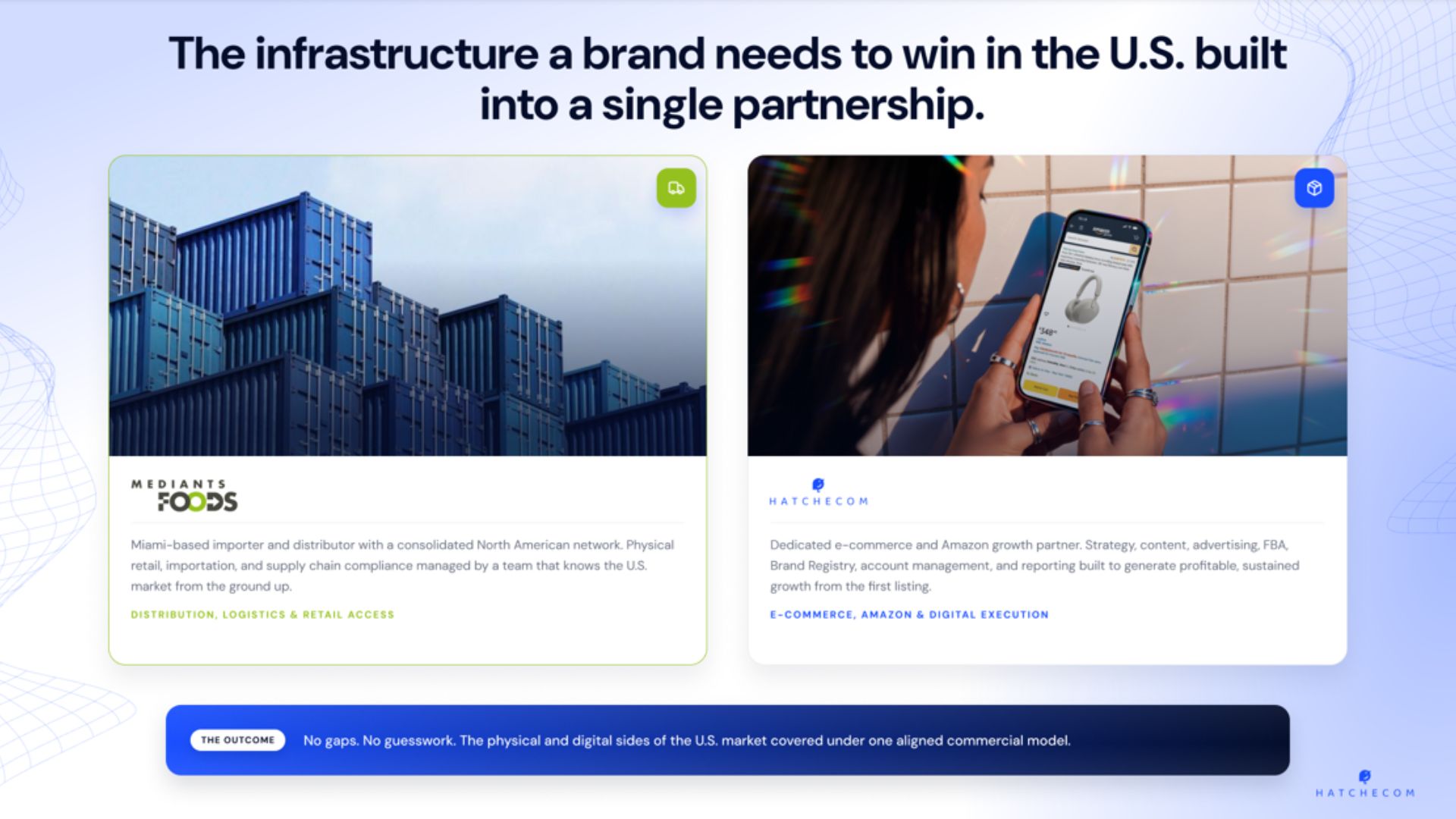
This is particularly relevant for us at HatchEcom because we work in partnership with Mediants Foods, a Miami-based importer and distributor with an established North American network. For LATAM brands that require this infrastructure, Mediants supports the physical side of market entry, including importation, distribution, supply-chain compliance, and retail access, while HatchEcom manages the e-commerce and Amazon side, including strategy, content, advertising, FBA, Brand Registry, account management, and reporting.
Connecting those capabilities becomes increasingly important once the business begins generating demand. A brand can build momentum on Amazon, but if the supply chain cannot replenish inventory efficiently, maintain compliance, or support expansion into additional channels, growth eventually reaches an operational ceiling. The opposite is also true: having inventory and distribution in the U.S. does not create demand on its own. The marketplace strategy, positioning, content, advertising, and economics still need to work.
Especially for Latin American brands, I prefer to think about U.S. market entry as one connected system rather than a collection of vendors. Market validation informs the product and pricing strategy; that strategy determines the import and inventory requirements; Amazon generates real consumer signals; and those signals can eventually inform broader distribution, DTC, or retail expansion.
Think about trademark and Brand Registry early
Brand protection is another area that should start earlier than many companies expect. Amazon Brand Registry currently requires an eligible registered trademark or, in qualifying cases, a pending trademark application. Amazon also requires the brand name or logo to be permanently affixed to the product or packaging. Amazon explains the current Brand Registry requirements here.
That does not mean every brand needs to wait for a completed trademark registration before doing any market-entry work. It does mean that trademark and Brand Registry strategy should be considered early enough that they do not become an unexpected bottleneck once the brand is ready to grow.
Start with a focused assortment
Entering a large market does not require bringing the entire catalog on day one. For many brands, I would rather start with three or four hero products that give us a clean read on demand than introduce a large assortment before we know which products resonate with U.S. consumers.
The same principle applies to inventory. There is no universal number of units that every brand should send for its first shipment. Five hundred units might be an appropriate controlled test for one business and completely wrong for another. The decision depends on expected velocity, lead times, product dimensions, shelf life, seasonality, cash flow, and replenishment capabilities.
The objective is to send enough inventory to generate meaningful market evidence without putting unnecessary capital at risk. As sales begin to come in, those assumptions can be replaced with actual demand and replenishment data.
Build the listing for the U.S. shopper
Getting a listing live is only one part of Launch. The product page needs to communicate the product in the language and context of the U.S. category, which means more than translating an existing listing into English.
Titles, bullets, imagery, A+ Content, keywords, benefits, comparison points, claims, and product education all need to answer the questions a U.S. shopper has while comparing the product with alternatives. If a shopper cannot quickly understand what the product is, who it is for, why it is different, and why its price makes sense, advertising will not solve the problem. It will simply pay to send more people to a page that does not convert.
We explore that issue in more detail in Why Your Amazon Product Page Isn’t Converting the Traffic You Send It.
At the end of Launch, the objective is not simply to celebrate that the product is live. The objective is to start generating real market evidence that can inform what happens next.
Stage 3: Grow. Turn market evidence into a repeatable system
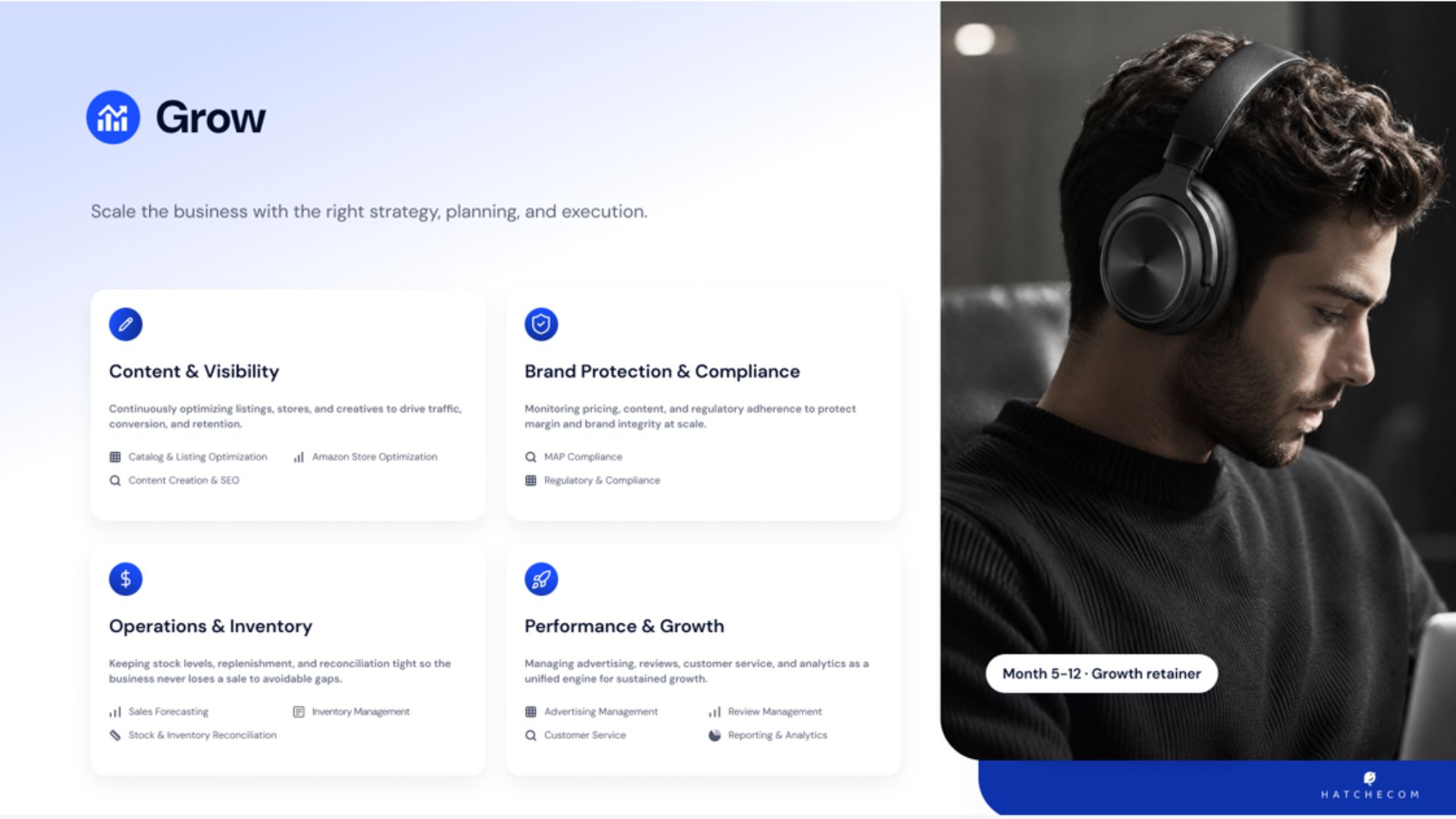
Once products are live and customers begin buying, the brand gains access to something no market research deck can fully reproduce: real behavior. You can now see actual conversion rates, search terms, advertising performance, inventory velocity, reviews, returns, and repeat purchasing behavior.
At this point, the job changes from launching to learning and growing. HatchEcom organizes this stage around four connected areas: Content & Visibility, Brand Protection & Compliance, Operations & Inventory, and Performance & Growth.
Advertising should accelerate a working offer
Amazon Ads becomes an important growth lever at this stage, but I would not use advertising to prove that a weak offer deserves to exist. Advertising should accelerate an offer whose underlying economics, positioning, and conversion fundamentals already make sense.
Once sales begin, we can ask much better questions. Which search terms are actually generating orders? Which products deserve more investment? Which keywords can eventually move toward stronger organic contribution? How much customer acquisition can the contribution margin support? Where are we paying for traffic without getting enough conversion in return?
The objective is not simply to increase revenue. It is to build profitable, repeatable demand. That distinction matters because topline growth can hide weak economics for a surprisingly long time.
Inventory becomes a financial decision
Inventory management becomes equally important as velocity increases. Too little inventory creates stockouts, lost sales, and interrupted momentum. Too much inventory traps working capital, increases storage exposure, and can turn growth into a cash-flow problem.
As sales begin to grow, inventory therefore becomes a financial decision as much as an operational one. The brand needs to forecast demand, replenish at the right time, maintain healthy sell-throughs, and avoid tying unnecessary working capital up in stock. The goal is to keep enough inventory to support growth without allowing inventory to become the reason that growth stops being profitable.
In HatchEcom’s growth model, sales forecasting, inventory management, stock reconciliation, advertising management, customer service, reviews, and reporting all sit within the same operating system. Growth on Amazon rarely comes from one lever working exceptionally well. It comes from those pieces working together.
Amazon does not have to be the destination
A successful Amazon business can become the foundation for a broader U.S. strategy. Once you understand which products move, which messages convert, what consumers search for, how much demand costs to acquire, and how the economics behave at scale, you can make much better decisions about DTC, Walmart, additional marketplaces, retail, or a broader assortment.
Amazon and DTC can also reveal very different parts of consumer behavior. Amazon is exceptionally useful for understanding high-intent marketplace demand, while a DTC channel can provide a different view of acquisition, repeat behavior, bundles, email relationships, and lifetime value. We explore those differences in Amazon vs. Shopify Data: What Each Channel Sees and What Neither Shows Alone.
The important point is that expansion should follow evidence. HatchEcom’s roadmap reflects that progression: Exploration comes before Launch, Launch begins producing the first real sales signals, Grow builds the operating engine, and broader Scale follows once the model demonstrates stronger and more repeatable performance.
The biggest mistake is treating all three stages as one launch
When a company says, “We’re launching in the U.S.,” that sentence can hide a long list of decisions: category opportunity, pricing, margins, product-market fit, compliance, importation, Amazon setup, content, inventory, advertising, and eventually broader distribution.
Trying to solve all those questions at the same time is where unnecessary risk begins. The most common problems we see are not caused by one dramatic mistake. They tend to come from gaps between functions: the product arrives before compliance is fully resolved, the retail price was decided before the real landed economics were modeled, advertising begins before the PDP can convert, or demand grows faster than the supply chain can replenish it.
The alternative is not to enter the U.S. slowly. It is to enter in the right order. Explore before committing significant capital, launch what you have validated, and grow what the market proves. Each stage should reduce uncertainty and make the next investment easier to justify.
That is a very different approach from sending inventory to the U.S. and seeing what happens. It also gives leadership a much clearer question to use throughout the process: What evidence do we have that justifies the next dollar of investment?
For brands evaluating Amazon or a broader U.S. market entry, HatchEcom brings together market intelligence, business economics, marketplace execution, content, advertising, inventory, data, and growth operations. For Latin American brands that also need physical market-entry infrastructure, our partnership with Mediants Foods connects that digital strategy with importation, logistics, distribution, supply-chain compliance, and retail access in the U.S.
The objective is not simply to get your products into the United States. It is to build a business that is ready to grow once they get here.
Talk to HatchEcom about your U.S. market-entry plan.
Frequently Asked Questions
What does a brand need before launching on Amazon U.S.?
Before launching, a brand should validate U.S. demand, competitive positioning, pricing, landed economics, and product-market fit. Once the opportunity is validated, it needs the appropriate operating and compliance structure, Amazon account and catalog setup, U.S.-ready content, fulfillment, and initial inventory. After launch, advertising, inventory management, content optimization, compliance, and financial performance need to operate together to create sustainable growth.
What should a brand validate before entering the U.S. market?
A brand should understand category demand, competitive intensity, whitespace, U.S. price architecture, landed costs, expected marketplace expenses, margin potential, and whether its product and positioning fit U.S. consumer expectations. The objective is not simply to determine whether the category is attractive, but whether that specific brand has a viable way to compete within it.
Should market research happen before opening an Amazon Seller account?
Yes. Opening an Amazon account does not establish whether a product can compete for profitably. Category demand, competition, U.S. pricing, landed costs, product readiness, and expected marketplace economics should be understood before significant inventory and growth capital are committed.
Does a Latin American company need a U.S. company to sell on Amazon U.S.?
Not necessarily. Amazon states that businesses based outside the U.S. may be able to sell on Amazon U.S. without forming a U.S. legal entity or opening a U.S. bank account. Whether creating a U.S. entity makes sense depends on the company’s tax, legal, import, operational, and commercial strategy, so brands should determine the appropriate structure for their specific situation.
How can HatchEcom help a Latin American brand enter the U.S.?
HatchEcom supports the digital and commercial side of U.S. market entry, from market intelligence and business economics through Amazon launch, content, advertising, inventory, analytics, and growth operations. Through its partnership with Miami-based Mediants Foods, LATAM brands that require additional physical infrastructure can also connect that strategy with importation, distribution, supply-chain compliance, and retail access.
Does a brand need a trademark before selling on Amazon?
A trademark is not necessarily required simply to create an Amazon selling account, but an eligible registered trademark or qualifying pending application is required for Amazon Brand Registry. Brands planning to build a long-term Amazon presence should therefore consider trademark strategy early enough that it does not become a bottleneck later.
How much inventory should a brand send for its first Amazon U.S. launch?
There is no universal quantity. The right first shipment depends on expected sales velocity, replenishment lead time, seasonality, shelf life, product economics, logistics, and how much working capital the brand is prepared to commit. The goal should be to generate enough real-world demand data to inform the next investment without unnecessarily overcommitting inventory.
Should a brand launch its entire catalog on Amazon U.S.?
Not always. For many brands, starting with a focused group of hero products makes it easier to test demand, pricing, conversion, advertising economics, and operational requirements before committing resources to a broader assortment.
What comes after a successful Amazon U.S. launch?
Once the initial products demonstrate repeatable demand, brands can optimize advertising, content, inventory, and profitability before deciding where to expand next. Depending on the business, that could mean additional Amazon SKUs, DTC, Walmart or other marketplaces, broader distribution, or physical retail.