
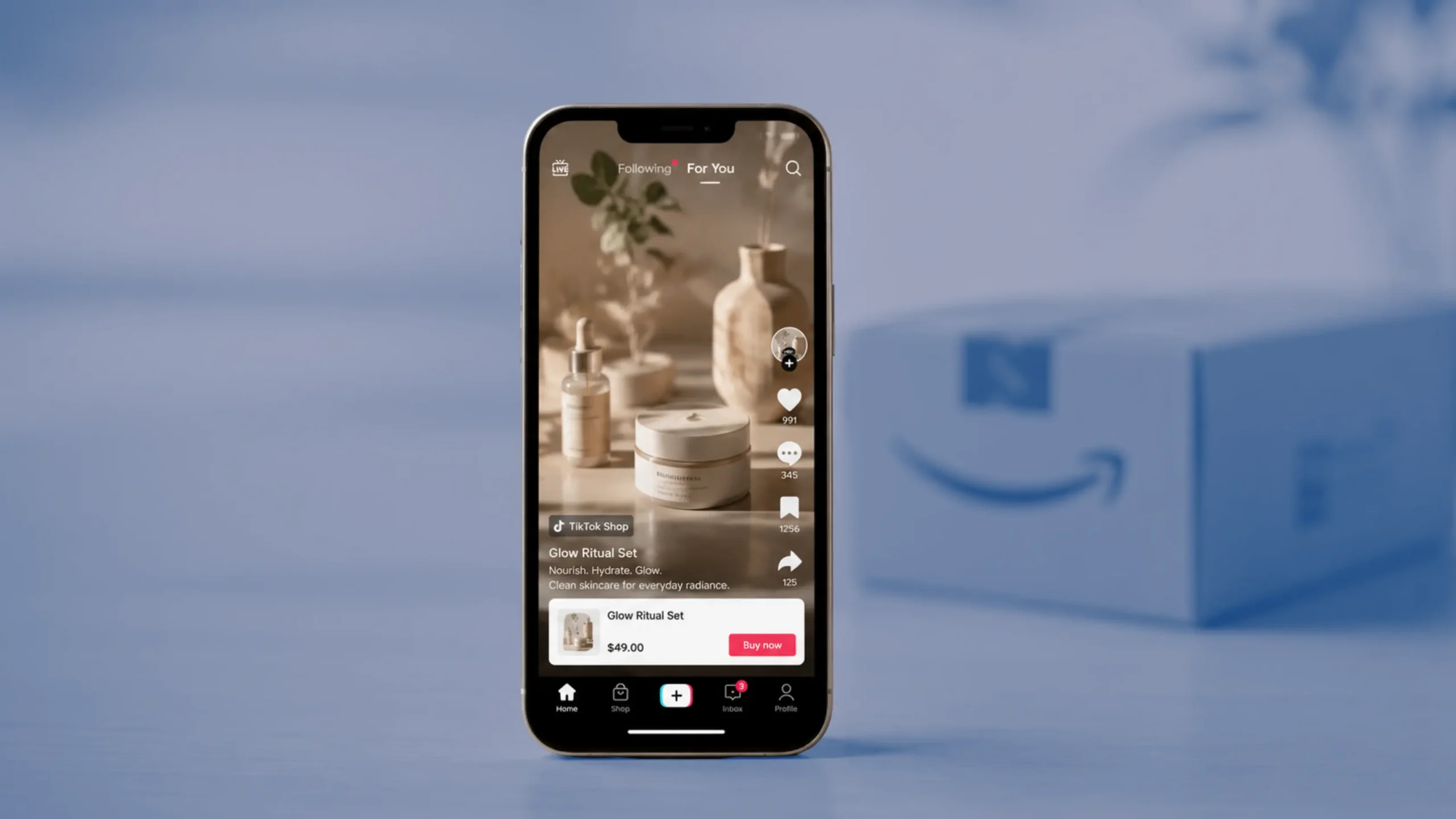
Someone scrolls TikTok, sees a product they did not know they wanted, and feels the pull to buy it. Then they do something that quietly breaks a lot of marketing plans: they open a different app to actually make the purchase.
That pattern is now common enough that it made the cover of Forbes. A recent Forbes piece reported on a TikTok Shop sponsored survey finding that TikTok Shop is now the top way consumers discover new products. But the operators Forbes spoke to described what happens next: the discovery lands on TikTok, and the purchase often lands somewhere else. Frequently on Amazon.
So the honest way to frame TikTok Shop versus Amazon is that it is not really a versus at all. They are doing two different jobs. One is where people find you. The other is where a lot of them decide to pay. The brands that struggle are the ones that treat those two jobs as the same job, or worse, as each other’s competition.
Why did TikTok Shop become the discovery engine?
TikTok Shop became the place people discover products because it is built for attention, not for shopping the way Amazon is built for shopping. You do not go to TikTok with a shopping list. You go to be entertained, and the product finds you in between.
One brand owner in the Forbes piece put it better than any strategy deck could. People do not go to Amazon to be entertained, he said. They go to TikTok to be entertained. That single line explains the whole dynamic. TikTok is where a butternut squash in an underwear video can sell a product, because the entertainment carries the discovery. Amazon has no equivalent to that, and it does not try to.
This is also why live content works so well on the platform. The rawness is the point, and it is hard for a big brand to match because everything has to clear legal and marketing first. We wrote about how that mechanic actually converts in How TikTok Live Is Powering E-Commerce Strategy and Conversion, and the short version is that TikTok rewards volume, personality, and speed, which is exactly what most polished brand channels are not set up to produce.
Why does the purchase still happen on Amazon?
The purchase still happens on Amazon because that is where people go when they have already decided and just want to buy with no friction. Fast shipping, a login they already have, reviews they trust, a returns process they do not have to think about. By the time a shopper is ready to pay, TikTok’s job is done and Amazon’s job begins.
Here is the part that catches brands off guard. The move from TikTok to Amazon is not instant. Someone sees your product tonight and searches for it on Amazon an hour later, or the next morning, or the following weekend. That gap in time is where the sale is either captured or quietly handed to whoever shows up best when the shopper finally searches.
And whoever shows up best is not always you. If your listing is thin, your reviews are light, or a competitor’s product page is simply more convincing, the demand you paid to create on TikTok converts into a sale for someone else. This is the same channel-handoff blind spot we mapped in Amazon vs Shopify data: what each channel sees and what neither shows alone. Each platform only sees its slice of the journey, so the leak between them is easy to miss.
The gap nobody owns
Most brands have a person or an agency for TikTok, and a person or an agency for Amazon. Very few have anyone who owns what happens between them. The handoff lives in the space between two teams that often do not talk to each other, and that space is where sales go to disappear.
It usually sounds harmless on the org chart. The content team drives views and engagement. The marketplace team manages the listings and the ads. Both report good numbers. Meanwhile the shopper who discovered the brand on TikTok lands on an Amazon search result that does not quite match what they saw, hesitates, and buys the alternative. Nobody’s dashboard flags it, because nobody’s dashboard covers the gap.
This is the real question a CEO should be pressure-testing. Not whether to be on TikTok Shop or Amazon. The question is what happens to the attention TikTok creates once it leaves the app, and who on the team is actually accountable for that moment.
What does capturing the handoff actually take?
Capturing the handoff means making sure that when the TikTok-inspired shopper finally searches on Amazon, everything they find confirms the decision they were already leaning toward. It comes down to three things being ready before the traffic arrives.
The first is a listing that closes. If someone searches for your product and the page does not quickly answer what it is, how big it is, and why it is worth it, the moment slips. We broke down exactly where product pages lose these shoppers in Why your Amazon product page isn’t converting the traffic you send it. A page that leaks demand turns paid TikTok attention into a competitor’s sale.
The second is a review base that reassures. A first-time buyer who found you an hour ago on TikTok has no relationship with your brand yet, and reviews are what stand in for that trust. A product with a thin review base loses to one that looks established, even when it is the better product. Building that foundation is its own discipline, which we covered in How to Build Your First 100 Reviews on Amazon US From Scratch.
The third is content that survives the gap. The shopper remembers a feeling from the video, not a spec sheet. Your Amazon presence has to reconnect with that feeling fast, through images and content that echo what they saw, so the person who was entertained on TikTok recognizes the same product when they are ready to buy on Amazon.
So should you be on TikTok Shop or Amazon?
Both, but that is the easy part of the answer. The harder and more useful truth is that spending on content without spending on the infrastructure that converts it is close to funding someone else’s Amazon listing. You pay to create the demand, and a better-prepared competitor collects it.
The brands that are winning right now are not choosing between the two platforms. They are managing a pipeline that runs from discovery to purchase across both, and they treat the handoff as a thing someone owns, not a thing that happens by luck. That is the omnichannel shift we described in Rethinking Omnichannel: How the 2026 Customer Actually Decides, and TikTok-to-Amazon is its clearest example yet.
Frequently asked questions
Does TikTok Shop drive Amazon sales?
Often, yes, but indirectly. TikTok Shop is now the top way many consumers discover new products, and a large share of those shoppers complete the purchase elsewhere, frequently on Amazon. The discovery happens on TikTok and the transaction happens on Amazon, which means the two platforms work as a pipeline rather than as competitors.
Should I sell on TikTok Shop or Amazon?
For most brands the answer is both, because they do different jobs. TikTok Shop is built for discovery and entertainment, while Amazon is where shoppers go to buy with low friction once they have decided. The bigger question is not which platform to pick, but who on your team owns the handoff between the two.
Why do shoppers discover products on TikTok but buy on Amazon?
Because the two platforms serve different moments. People go to TikTok to be entertained, so discovery happens there naturally. When they are ready to pay, they move to Amazon for the fast shipping, trusted reviews, and easy returns they already know. The move is often not immediate, which is why your Amazon presence has to be ready when they search later.
How do I capture TikTok demand on Amazon?
Make sure your Amazon presence is ready before the traffic arrives: a product page that clearly closes the sale, a review base that reassures a first-time buyer, and content that visually reconnects with what the shopper saw on TikTok. The goal is that when they search for you later, everything they find confirms the decision they were already leaning toward.
Attention is not the same as a sale
TikTok Shop is very good at creating attention. Amazon is very good at closing it. The mistake is assuming the first automatically becomes the second. It does not, and the distance between them is where a lot of good marketing money goes to fund a competitor’s growth. The brands that win the next couple of years will be the ones that stop treating discovery and conversion as separate wins and start managing the whole pipeline as one. At HatchEcom, that pipeline is what our Growth Team is built to run.
If your content is creating demand that you are not sure you are capturing, book a call with the team and we will help you find where it is going.