
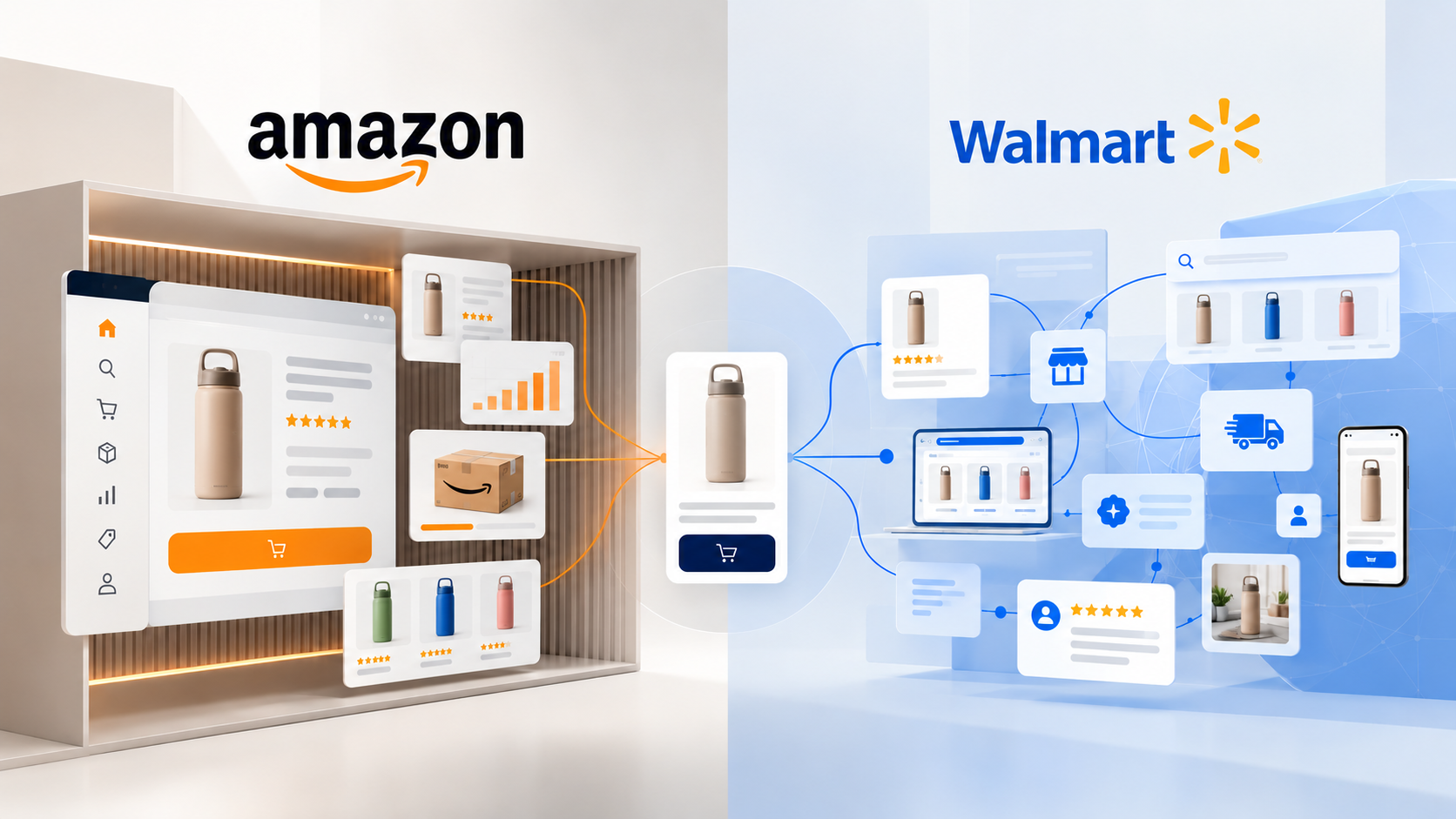
In the span of a few weeks, the two largest retailers in the US made opposite-looking moves on AI shopping. Walmart opened a front door for outside agents, and Amazon spent the same period strengthening its own. Most of the coverage framed it as a fight with a winner. That framing misses the point.
The useful question for a brand is not which retailer wins the AI shopping race. It is whether your brand is positioned to be chosen in both, because each one is building a different model for how an AI helps a customer buy, and your products will have to perform inside both of them. The next competitive advantage in ecommerce may depend less on how well you rank inside a single marketplace and more on how well you show up across these new AI-mediated experiences.
The AI shopping race just took two different turns
On October 21, Walmart announced its Agent Gateway, a direct connection that lets authorized AI agents shop Walmart and Sam’s Club on a customer’s behalf, along with Agent Profiles where customers set spending limits and approve purchases (Walmart). It begins as a beta for enterprises and developers, so it is not a universally available system yet. The bet is straightforward: an agent told to find the best value will keep landing on Walmart’s everyday low prices.
Amazon has moved in what looks like the opposite direction. Last month it blocked Meta’s Muse agent from browsing and buying on its platform, citing authorization, security, and control of the experience (Axios). But reading that as Amazon rejecting agentic commerce would be wrong. Today, Amazon added more than 100 new capabilities to Alexa for Shopping, letting customers manage lists, subscriptions, gifts, deliveries, payments, and returns through conversation, and it reports more than 400 million customers used Alexa for Shopping in the past year. Amazon also lets its own assistant discover products outside Amazon through features like Shop Direct and Buy for Me.
So the real story is not Walmart opens, Amazon closes. It is that two giants are building different models for putting AI between the shopper and the shelf. Walmart is opening its marketplace to outside agents. Amazon is deepening a powerful assistant of its own while controlling who else gets to operate inside its ecosystem. (Amazon’s usage figures are company-reported and not independently audited, and using an assistant is not the same as fully autonomous buying.)
The real competition is for the customer relationship
Underneath the technology, both companies are competing for the same thing: ownership of the customer relationship in a world where a shopper might never open an app again.
Walmart’s model keeps the account, the purchase history, and the permissions on Walmart’s side, while letting an outside agent act within those rules. Notably, Walmart says its Gateway can help an agent find a customer’s usual products without handing the full purchase history to the agent’s provider, and that agents will see the same prices human shoppers do. Amazon’s model keeps the entire experience inside its own ecosystem, where it controls discovery, the assistant, and the data.
For brands, this is the shift that matters. Each retailer sees a different slice of the shopper, and now a different slice of the agent’s decision too. We wrote about how Amazon and a brand’s own channels already capture different parts of the journey in Amazon vs Shopify data: what each channel sees and what neither shows alone. Agentic shopping raises the stakes of that same truth: the retailer that owns the relationship increasingly shapes which products even enter the conversation.
What changes when an AI agent chooses the product?
When an AI agent does the choosing, part of the decision moves out of the places brands have spent years optimizing: search results, category pages, product pages, and ads. Some of it shifts to an automated comparison based on price, availability, specifications, reviews, and the shopper’s stated preferences. The exact criteria are not public, so it is too early to treat any of this as settled rules, but the direction is clear enough to prepare for.
Two implications stand out. For established brands, recognition and loyalty may still carry weight, especially when the agent already knows a customer’s habitual purchases. For emerging brands, the quality and completeness of product information may become a way to compete on very specific queries, even against bigger names, because an agent reads the data rather than the logo.
There is a second, quieter shift: repurchase may start to matter more than discovery. If an assistant remembers that a customer buys a particular shampoo, the brand can win the repeat order without the shopper ever browsing the category again. But if that product is out of stock or no longer competitive, the agent may propose an alternative, within the user’s permissions. A stockout in an agent-driven world is not just a lost sale, it is a potential handoff of a loyal customer. That makes availability and pricing discipline a bigger deal than ever, a theme we explored in Why the same customer buys the same product in different places.
Three questions every ecommerce leader should be asking
This is early. By one Coveo figure cited in the coverage, only 16% of shoppers currently say they are comfortable letting an AI assistant find and buy products for them. That low number is exactly why now is the moment to get ready, before the behavior becomes common and the rules harden. Three questions are worth pressure-testing.
First, how much of your growth plan depends on a single marketplace’s rules about who gets to shop there? If one platform’s agent policy changes, how exposed is your revenue?
Second, is your Walmart catalog as complete as your Amazon one? A Walmart-connected agent reads the Walmart version of your product. If that version is thinner, you are handing the agent a weaker case for your product than you would give a human.
Third, does your pricing hold up when an agent compares retailers in seconds? Walmart has said agents will see the same prices humans do, which means pricing inconsistency across channels becomes visible and consequential at machine speed.
What ecommerce leaders can evaluate now
Not everything here is actionable yet, but several things are. The table separates what you can assess today from what still depends on how these systems develop.
| Action | Priority | What to evaluate |
| Audit key products on Amazon and Walmart | High | Attributes, images, descriptions, price, and availability, matched across both |
| Test product searches in existing assistants | High | Which brands appear and how the recommendations are justified |
| Review repurchase vulnerabilities | High | Stock levels, substitution risk, price consistency |
| Assess sales concentration by marketplace | Medium | How dependent you are on a single platform’s rules |
| Follow the Agent Gateway rollout | Medium | Beta availability, attribution, and integration options |
The first row is the one to start with. If your Walmart catalog is thinner than your Amazon one, that gap is already costing you in human search, and it will cost you more when an agent is the one reading. We covered how to find those catalog and margin gaps in What an Amazon audit finds that your revenue report doesn’t.
Prepare before the rules settle
The temptation with a shift this early is to wait until the winner is obvious. But the advantage here does not go to the brand that guesses which retailer wins. It goes to the brand that is ready to be chosen in whichever experience the shopper uses, because the shopper is not going to pick one and stay there. Some will come to Amazon directly. Some will send an agent to Walmart. Brands get to sell to both, but only if they are prepared for both.
The practical move is to experiment now while the stakes are low: audit your catalogs across both retailers, test how existing assistants describe and recommend your products, and watch where your pricing and availability create risk. Build an adaptable strategy instead of betting everything on one platform’s model.
The biggest question is not whether Amazon or Walmart wins the AI shopping race. It is whether your brand is prepared to compete in both ecosystems. At HatchEcom, helping brands stay visible and chosen across marketplaces, as the rules of discovery change, is exactly what our Growth Team does.
Frequently asked questions
What is Walmart’s Agent Gateway?
Walmart’s Agent Gateway is a direct connection, announced October 21, 2026, that lets authorized AI agents shop Walmart and Sam’s Club on a customer’s behalf. It comes with Agent Profiles, where customers set spending limits and approve purchases. It is starting as a beta for enterprises and developers rather than a universally available feature, and Walmart has said connected agents will see the same prices human shoppers do.
Is Amazon against AI shopping agents?
No. Amazon blocked one specific external agent, Meta’s Muse, citing authorization and security, but it is actively expanding its own agentic shopping through Alexa for Shopping, which added more than 100 new capabilities in October 2026. Amazon also lets its assistant discover products outside Amazon through features like Shop Direct and Buy for Me. Its approach is to control who operates inside its ecosystem while building its own assistant, not to reject agentic commerce.
How should brands prepare for AI agent shopping?
Start with what is actionable today: make sure your product catalog is complete and consistent across both Amazon and Walmart, test how existing AI assistants describe and recommend your products, and check that your pricing and stock hold up when compared across retailers. Then watch how the Agent Gateway and similar systems develop before committing heavily to any one model. The goal is readiness across both ecosystems, not a bet on one.
Will AI agents change how brands advertise on marketplaces?
Possibly, and this is still an open question. Today brands invest in Amazon Ads and Walmart Connect to reach human shoppers browsing results pages. When an agent requests product data directly through an API instead of scrolling a page, it is not yet clear how sponsored placements, measurement, and attribution will work. It is a development worth tracking closely, because it could reshape how retail media budgets are spent
